

Where it goes: which scenarios
High-density offices, meeting rooms and hotel public areas where many clients connect at once. The tri-band design spreads load across 2.4, 5 and 6 GHz, separating low-rate IoT traffic from high-speed office traffic.
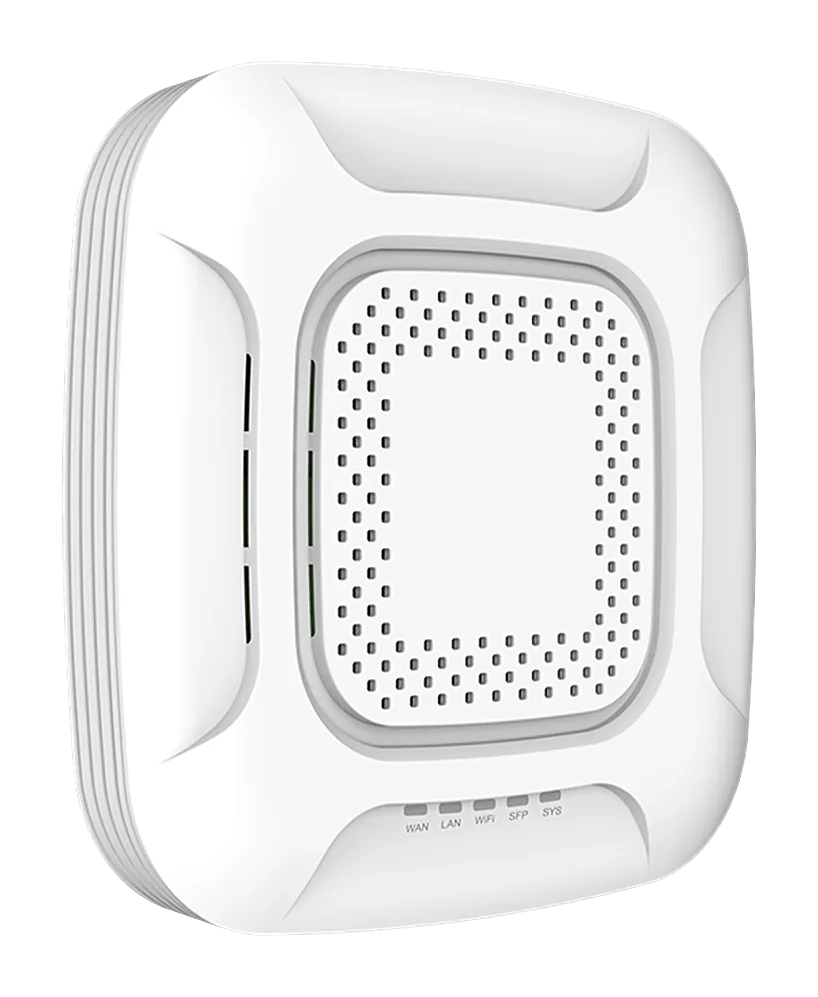
Omnidirectional antennas are built in and it mounts on the ceiling; power comes from 802.3bt PoE or DC 54V, so the fit-out only needs one network cable.
Where density is low, tri-band is overkill: a single office zone, a shop or a small meeting room is served by SmartNets AI6220 — dual-band 3000 Mbps, 120 clients per unit, also ceiling-mounted and PoE-powered.
Why it fits: three reasons
6 GHz is quiet: legacy clients stay on 2.4 and 5 GHz while new clients move to 6 GHz, so they stop competing.
10G fiber uplink: a gigabit copper port will not throttle it, and concurrent APs no longer crowd one uplink.
802.3bt: a switch delivering 90 W per port powers it, with no separate mains run.
Specifications
| Model | PH19000 |
|---|---|
| Frequency bands | 2.4G 2.400–2.484GHz|5G 5.150–5.850GHz|6G 5.925–7.125GHz |
| Wi-Fi protocols | 2.4G 802.11 b/g/n/ax/be;5G / 6G 802.11 a/n/ac/ax/be |
| Antennas | Built-in omnidirectional |
| Wireless rates | 2.4 GHz up to 1376 Mbps; 5 GHz up to 8646 Mbps; 6 GHz up to 8646 Mbps |
| Max clients | 1,536 clients |
| Interfaces | 1× 10G SFP+; 1× 10G auto-sensing WAN (802.3bt input); 1× 10/100/1000/2500M LAN; 1× USB |
| Power | PoE 802.3bt / DC 2.0 54V 1A |
| Dimensions | 220 × 220 × 42 mm |